


Quick answer: An OEM pest control product RFQ should state the target product or SKU, destination country, sales channel, expected quantity, branding, colour, packaging, required components, testing needs and delivery window. The more clearly these items are defined, the easier it is for a manufacturer to quote the correct configuration instead of a misleading base price.
Buyer note: An RFQ is not a substitute for regulatory review. The importer or brand owner should confirm the product claims, labels, registrations and documentation required in the destination market. The manufacturer should quote only the agreed scope and identify assumptions.
Why do vague OEM inquiries produce unreliable prices?
“Please send your best price for mouse traps” is an inquiry, but it is not yet a useful RFQ. The supplier still does not know which model, quantity, packaging, colour, destination or test requirement applies.
The first price returned to a vague request usually reflects the simplest standard configuration. Later additions such as individual boxes, printed logos, multilingual manuals, barcodes, special colours or additional inspection change the cost and schedule. The buyer may then feel that the supplier has changed the price, while the supplier is actually pricing a different product.
A strong RFQ reduces this ambiguity before samples and artwork begin.

1. Identify your company, market and sales channel
Start with basic commercial context:
- Company name and website.
- Country where the goods will be imported or sold.
- Main sales channel: pest control distribution, professional service, hardware retail, agriculture, e-commerce or another route.
- Whether the project is a new launch, replacement product or repeat programme.
- Main customer type and intended user.
This information helps the supplier understand whether the project needs bulk professional packing, retail presentation, Amazon-ready units or a distributor service pack.
The sales channel also affects the questions the buyer must resolve. A product intended for professional technicians may prioritise repeated servicing and bulk cartons. A retail product needs stronger shelf communication, barcode control and consumer instructions.
2. Define the target product and configuration
If you already selected an existing product, provide the exact SKU. If not, explain the target pest, application and preferred product format.
A useful product definition includes:
- Existing CNPestech SKU or reference photograph.
- Target pest or species category.
- Indoor, outdoor, sheltered or exposed placement.
- Required material or finish.
- Required accessories and included components.
- Whether the product is empty hardware, a monitoring kit or part of another complete system.
- Any critical size, weight or performance requirement.
Avoid sending only a competitor’s photograph with the instruction “make the same.” Explain which characteristics matter and confirm that you have the right to use any supplied design, artwork or protected feature.
3. State the quantity clearly
Quantity influences material purchasing, packaging method, printing process, production scheduling and freight planning.
Provide three numbers where possible:
- Sample requirement: how many units are needed for evaluation.
- Initial order quantity: the expected first production order.
- Annual forecast: a reasonable range, not an inflated promise.
If you do not know the final quantity, provide scenarios such as 1,000, 3,000 and 5,000 units. The supplier can then show how packing or printing costs change by volume.
MOQ should be evaluated for the complete configuration. A standard bulk-packed product may have a different MOQ from a special-colour product with printed retail boxes.
4. Specify branding and colour requirements
Branding can mean several different processes:
- Printed logo.
- Adhesive product label.
- Laser marking or another permanent mark.
- Molded or embossed brand feature.
- Branded key, accessory or service label.
- Custom product colour.
For quotation, send:
- Vector logo file where available.
- Required logo size and preferred location.
- Number of print colours.
- Pantone, RAL or approved colour reference.
- Whether exact colour matching or a standard factory colour is acceptable.
- Durability or adhesion requirement for the marking.
An image copied from a website is not a production-ready logo file. Artwork quality and colour expectations should be resolved before sample approval.
5. Describe the complete packaging structure
Packaging is one of the largest sources of late OEM changes. Break it into levels.
Unit packaging
Choose bulk polybag, label, sleeve, colour box, blister, display pack or another format. State which components, keys and instructions must be inside each unit.
Inner pack
Specify the number of units, arrangement and whether an inner carton or display tray is required.
Master carton
State the preferred quantity per carton, maximum gross weight if applicable, shipping marks and any carton-strength or sealing requirement.
Retail and compliance content
Identify who supplies and approves:
- Product name and claims.
- Instructions and warning language.
- Barcode or GTIN.
- Importer or responsible-party details.
- Country-of-origin statement.
- Recycling or disposal marks.
- Required translations.
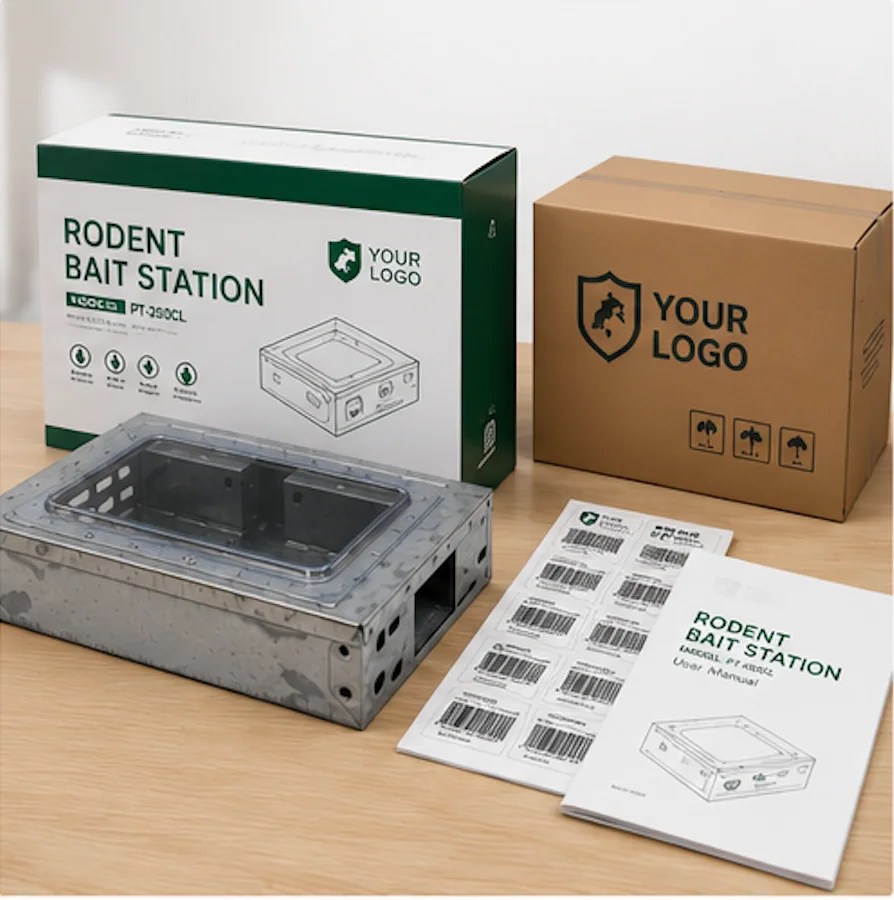
The manufacturer can support layout and production, but the buyer should confirm that the final statements are permitted in the destination market.
6. List testing, inspection and documentation requirements
Do not wait until the order is nearly finished to request test reports or third-party inspection.
The RFQ should state whether you require:
- Material declaration.
- Product-specific function test.
- Colour or dimensional inspection.
- Barcode verification.
- Packaging or carton test.
- Customer-defined sampling plan.
- Pre-shipment inspection.
- Third-party laboratory or inspection company.
- Product photographs, packing photographs or loading records.
- A specific document for customs or a retailer.
Name the required standard, method and responsible party where possible. “International certification” is too vague to price or schedule.
For products used with pesticides, the locally registered pesticide label and applicable law control the permitted use and claims. The hardware supplier should not be asked to create unsupported pesticide directions.
7. Give a realistic delivery target and shipping basis
State whether the date refers to sample dispatch, production completion, port departure or arrival at the buyer’s warehouse.
Include:
- Required sample date.
- Desired mass-production completion window.
- Destination country and port or postcode.
- Preferred Incoterm, if known.
- Air, courier, LCL or FCL expectation.
- Pallet or container-loading requirement.
- Any retailer appointment or launch date that cannot move.
Production lead time normally begins after the commercial terms, sample, product specification and artwork are approved. It should not be counted from the first general inquiry.
8. Identify the files and approvals you will provide
An RFQ moves faster when responsibility is clear.
| Item | Buyer should provide | Supplier should confirm |
|---|---|---|
| Product | Target SKU, application and required changes | Available configuration and feasibility |
| Logo | Vector artwork and usage approval | Marking method, area and sample result |
| Colour | Named colour reference | Material compatibility and expected variation |
| Packaging | Structure, language, claims and barcode data | Dieline, printing method, MOQ and packing quantity |
| Compliance | Destination-market requirements and approved wording | Documents included in the quoted scope |
| Inspection | Test method and acceptance criteria | Inspection stage, record and cost |
| Shipping | Destination and preferred term | Carton data, production window and freight basis |
Information gaps that change a quotation
| Missing information | Likely quotation problem |
|---|---|
| No SKU or target dimensions | Supplier prices a different model from the one expected |
| No quantity | Printing, packing and unit-price assumptions are unreliable |
| No destination country | Labelling, documents and freight cannot be reviewed correctly |
| “Custom packaging” without a format | Quote may include only a basic label rather than a colour box |
| No logo or colour specification | Sample and production setup cannot be assessed |
| Undefined test requirement | Testing cost and lead time appear later |
| “Urgent” without a required date | Sample, production and transport milestones remain unclear |
A copy-ready RFQ template
Buyers can adapt the following email.
Subject: RFQ - [Product / SKU] - [Destination Market] - [Estimated Quantity]

Company:
Website:
Destination country:
Sales channel:

Target product or CNPestech SKU:
Target pest/application:
Required configuration and accessories:
Material/colour requirement:

Sample quantity:
Initial production quantity:
Estimated annual volume:

Logo method and file attached:
Unit packaging:
Units per inner pack/master carton:
Manual and label languages:
Barcode/retailer requirements:

Required tests or inspection:
Required documents:

Requested sample date:
Requested production completion date:
Destination port/postcode:
Preferred Incoterm:

Please identify all assumptions, tooling charges, packaging MOQ,
sample cost and estimated lead time in the quotation.
How to compare quotations fairly
The lowest unit price is not necessarily the lowest comparable price. Check whether each quotation includes the same:
- Product version and material.
- Colour and marking.
- Keys, components and manuals.
- Unit and export packaging.
- Tooling or setup charges.
- Testing and inspection.
- Incoterm and freight scope.
- Payment terms.
- Sample and production lead time.
Ask suppliers to list exclusions and assumptions. A clear quotation may appear longer, but it gives the buyer more control.
Common RFQ mistakes
Requesting “best quality” without measurable requirements
State the material, function, appearance and test expected. Quality is the degree to which the approved requirements are met.
Asking for an unrealistic price before selecting packaging
Retail boxes, inserts, labels and manuals may materially affect cost and MOQ.
Sending conflicting files through several channels
Keep one current artwork and specification set. Mark obsolete versions clearly.
Treating the annual forecast as the first purchase order
Give a credible initial quantity and a separate annual estimate. This helps the supplier plan without confusing a forecast with a commitment.
Leaving regulatory wording to the factory
The brand owner or importer should approve claims and destination-market wording. The manufacturer can produce the approved artwork but should not invent legal claims.
How CNPestech handles an OEM RFQ
CNPestech can review existing models across rodent control, insect control, live animal traps, mole and gopher products, and professional tools. The practical quotation sequence is:
- Confirm the target model and application.
- Review quantity, colour, logo and included components.
- Define packaging and documentation.
- Identify sample, test and inspection requirements.
- Confirm estimated production and shipping basis.
- Issue a quotation that lists the agreed scope and assumptions.
See the current product range and OEM service options before sending the RFQ.
FAQ
Can I request a quote without knowing the exact SKU?
Yes. Describe the target pest, application, product format, destination market, quantity and required packaging. CNPestech can identify candidate existing models for comparison.
Should I send my target price?
A realistic target can help the supplier assess the configuration, but it should not replace a product specification. Explain which features and packaging elements are fixed and which can be adjusted.
When is a mold fee required?
Standard colour, logo and packaging changes may not require a new product mold. Structural or geometry changes can require mold modification or new tooling. Feasibility must be reviewed from drawings and the requested change.
Who owns the packaging artwork?
Ownership and permitted use should be agreed in writing. The buyer should confirm rights to logos, images, claims and supplied designs. Ask whether editable source files are included in any design charge.
Can MOQ be reduced for a trial order?
It depends on the product, colour, components and packaging. A standard product with bulk packing may support a different trial quantity from a custom-colour product with printed retail packaging.
How long does an OEM project take?
Timing depends on product availability, customization, sample approval, artwork, testing and order quantity. Request separate estimates for sample preparation, approval, mass production and transport.
Prepare an RFQ CNPestech can act on
Attach the completed checklist, logo files and any packaging reference. CNPestech can then respond with a relevant product configuration, assumptions, sample plan and commercial quotation.